

Designing a thriving flower garden in full sun is one of the most rewarding endeavors in ornamental horticulture.
When a planting bed receives six to eight hours or more of relentless, unfiltered direct sunlight each day, conventional delicate plants wilt and scorch. But when you match those intense solar conditions with resilient sun-worshipping perennials, nectar-rich annuals, and heat-loving architectural grasses, your garden transforms into an explosive tapestry of brilliant color, intoxicating perfume, and humming biodiversity from late spring through the hard frosts of autumn.
Whether you’re contending with dry clay slopes, designing a high-traffic backyard patio border, or curating a cut-flower sanctuary for daily bouquets, here are 15 breathtaking flower garden ideas for full sun paired with battle-tested plant combinations and horticulturist design principles.
Full Sun Flower Garden Comparison Matrix
| Garden Theme & Style | Signature Sun-Loving Flowers | Peak Bloom Window | Drought Tolerance | Garden Vibe |
|---|---|---|---|---|
| #01 English Cottage Sun Border | David Austin Roses, Foxgloves, Delphiniums, Catmint | Late Spring to Late Summer | Moderate | Romantic, Informal, Abundant |
| #02 Mediterranean Gravel Garden | English Lavender, Santolina, Russian Sage, Sea Holly | Early Summer to Mid Autumn | Extreme (Xeriscape) | Rustic Tuscan, Calming, Aromatic |
| #03 Vibrant Pollinator Oasis | Purple Coneflower, Butterfly Weed, Bee Balm, Coreopsis | Mid Summer to Frost | High | Ecological, Lively, High-Contrast |
| #04 Modern Prairie & Ornamental Grass Swath | Karl Foerster Grass, Sedum Autumn Joy, Allium, Rudbeckia | Mid Summer through Winter | Very High | Architectural, Dynamic, Low-Maintenance |
| #05 Sun-Baked Alpine Rockery | Creeping Thyme, Hardy Ice Plant (Delosperma), Sempervivum | Late Spring to Fall | Extreme | Rugged, Ground-Hugging, Succulent |
| #06 Backyard Cut-Flower Sanctuary | Benary’s Giant Zinnias, Dinnerplate Dahlias, Cosmos, Snapdragons | Early Summer to Frost | Moderate (Regular Water) | Productive, Cheerful, Bouquets-Ready |
| #07 Jewel-Tone Tropical Border | Bronze-leaf Canna Lilies, Red Hot Pokers, Lantana, Sweet Potato Vine | Summer to First Hard Freeze | Moderate to High | Exotic, Saturated, Bold Architectural |
| #08 Fragrant Sunset Sensory Garden | Bearded Iris, Royal Heliotrope, Sweet Alyssum, Night Stocks | Spring through Autumn | Moderate | Intimate, Perfumed, Golden-Hour Glow |
| #09 Tiered Cedar Raised Bed Tapestry | French Marigolds, Trailing Nasturtiums, Salvia, Calendula | Late Spring to Late Fall | Moderate | Structured, Geometric, Edible Blooms |
| #10 Monarch & Swallowtail Highway | Verbena bonariensis, Swamp Milkweed, Mexican Sunflower (Tithonia) | Mid Summer to Frost | High | Airy, Kinetic, Biodiversity Haven |
| #11 Soft Romantic Pastel Perennial Border | Sarah Bernhardt Peonies, Pastel Yarrow, Lamb’s Ear, Baby’s Breath | Late Spring to Mid Summer | Moderate to High | Dreamy, Timeless, Soft Textures |
| #12 Sunny Terracotta Container Cluster | Million Bells (Calibrachoa), SunPatiens, Trailing Bacopa, Sweet Potato Vine | Spring to Heavy Frost | Moderate (Daily Check) | Curated Patio, Mediterranean Courtyard |
| #13 Midnight & Gold High-Contrast Border | Black Mondo Grass, Salvia ‘Caradonna’, Rudbeckia ‘Goldsturm’, Coreopsis | Early Summer to Mid Autumn | High | Dramatic, Moody, Modern Contrast |
| #14 Naturalized Native Wildflower Meadow | California Poppies, Blue Cornflowers, Cosmos, Queen Anne’s Lace | Late Spring through Autumn | Very High | Carefree, Whimsical, Self-Seeding |
| #15 Autumn Revival Late-Season Showcase | New England Asters, Hardy Mums, Goldenrod (Solidago), Flowering Cabbage | Late August through November | Moderate to High | Warm Jewel Tones, Frost-Hardy, Rich |
#01. The Classic English Cottage Sun Border
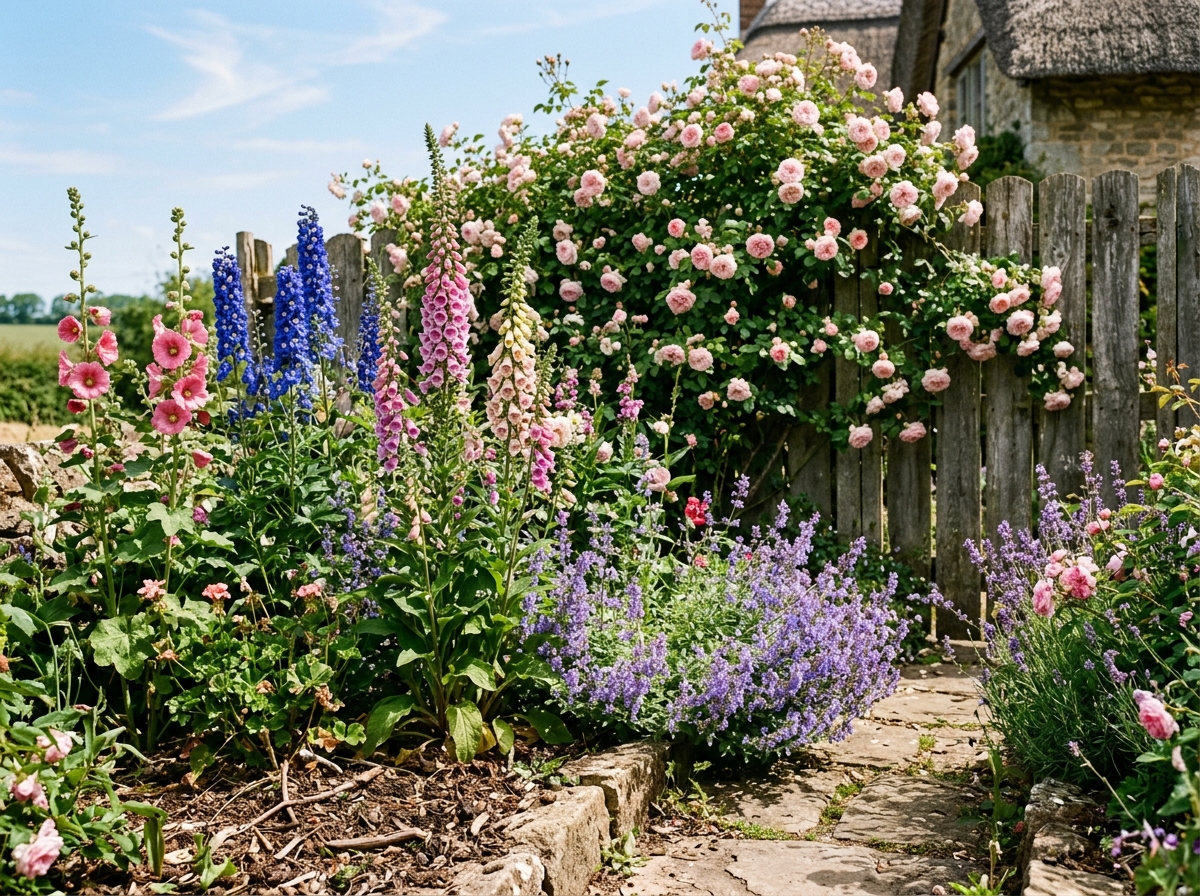
The hallmark of an authentic English cottage garden is layered informality—where every square inch of sunlit earth produces billowing blooms, textured foliage, and sweet fragrances. While shade can make cottage borders damp and prone to mildew, a full sun location allows English roses, delphiniums, and hollyhocks to reach their full architectural height with dense, bud-laden stems.
Signature Flower Palette
- Climbing English Roses (‘Gertrude Jekyll’ or ‘Generous Gardener’)
- Common Foxglove (Digitalis purpurea)
- Pacific Giant Delphiniums (Delphinium elatum)
- Catmint (Nepeta x faassenii ‘Walker\’s Low’)
- Hardy Geranium (‘Rozanne’)
Design Formula & Layering Secrets
Place climbing roses and 5-foot delphiniums firmly against an aged wooden picket fence or stone garden wall at the rear. Plant staggered mid-tier spires of biennial foxgloves and hollyhocks in groups of three. Finally, edge the front border with billowy lavender and Nepeta ‘Walker’s Low’ so they spill gracefully over flagstone pavers, softening harsh straight lines.
Growing Conditions & Maintenance: Thrives in USDA Zones 4–9. Requires nutrient-dense, humus-rich soil amended with well-rotted farmyard manure or garden compost. While sun-loving, English roses and delphiniums need consistent moisture and a 3-inch organic wood chip mulch to keep their root zones comfortably cool.
🌿 Horticulturist Pro-Tip: Cut back Nepeta by two-thirds immediately following its first June flush. Within 14 days, it will produce a tidy second mound of minty foliage and electric blue blossoms that will last until October.
#02. The Mediterranean Gravel & Lavender Garden
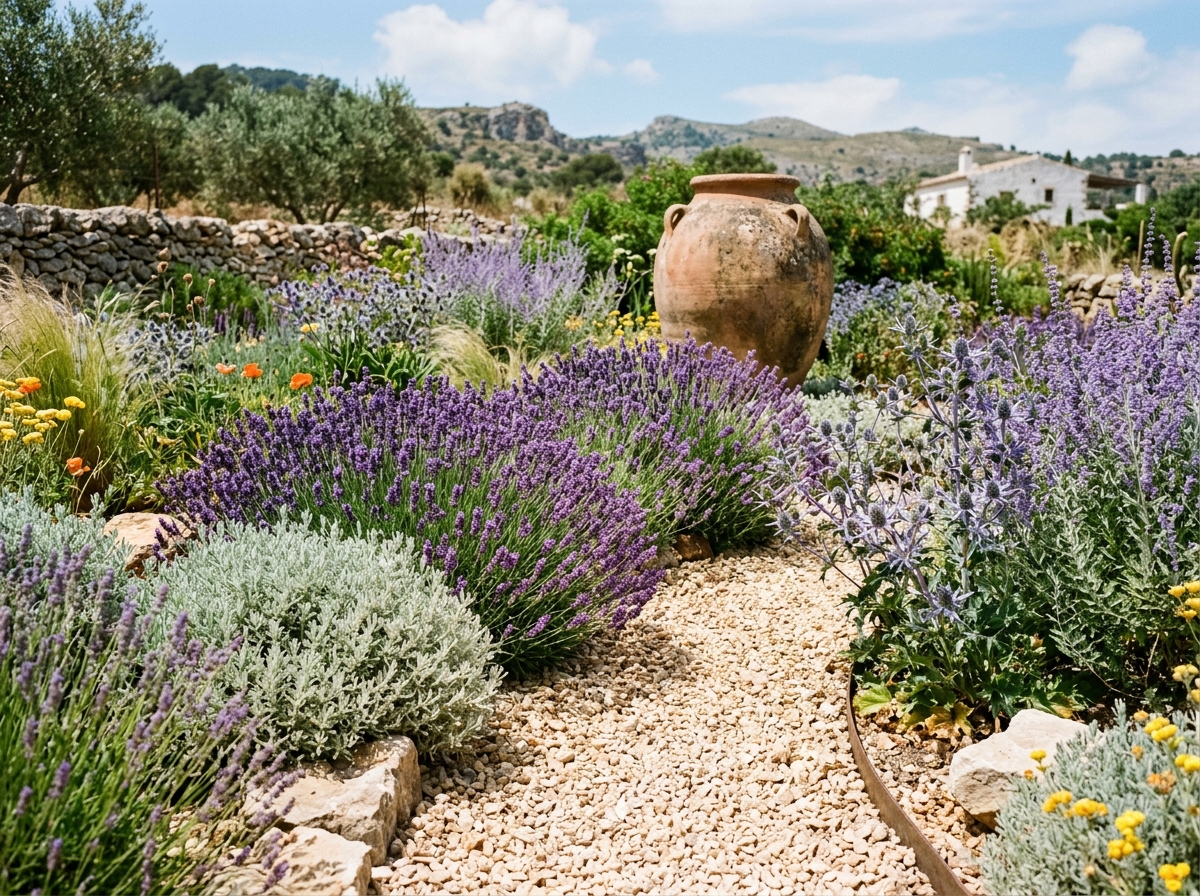
If your garden receives scorching midday sun, baking winds, and thin, poor, or rocky soil, the Mediterranean gravel garden is the ultimate low-maintenance solution. By swapping conventional moisture-retentive bark mulch for a 2-inch layer of crushed beige limestone gravel, you replicate the arid garrigue hills of southern France and Greece.
Signature Flower Palette
- English Lavender (Lavandula angustifolia ‘Munstead’ or ‘Hidcote’)
- Russian Sage (Salvia yangii / Perovskia atriplicifolia)
- Cotton Lavender (Santolina chamaecyparissus)
- Mediterranean Sea Holly (Eryngium bourgatii)
- Globe Thistle (Echinops ritro)
Design Formula & Layering Secrets
Plant in asymmetrical, rounded drifts rather than rigid linear rows. Combine rounded dome-shaped silver Santolina and violet English lavender mounds with vertical, cloud-like stems of Russian sage. Place an unglazed, weathered terracotta amphora or limestone rock outcropping as an off-center focal anchor.
Growing Conditions & Maintenance: USDA Zones 5–9. Demands lean, sharply-draining soil with neutral to slightly alkaline pH. Excessive fertilizer or heavy clay soil is fatal to Mediterranean flora, causing leggy stems and winter root rot. Once established, this garden survives on rainfall alone.
🌿 Horticulturist Pro-Tip: Gravel mulch reflects intense solar heat upwards into the foliage while keeping the root crown bone-dry. Always prune lavender right after flowering by trimming one-third of the green growth, never cutting down into the old woody base.
#03. The Vibrant Pollinator Oasis
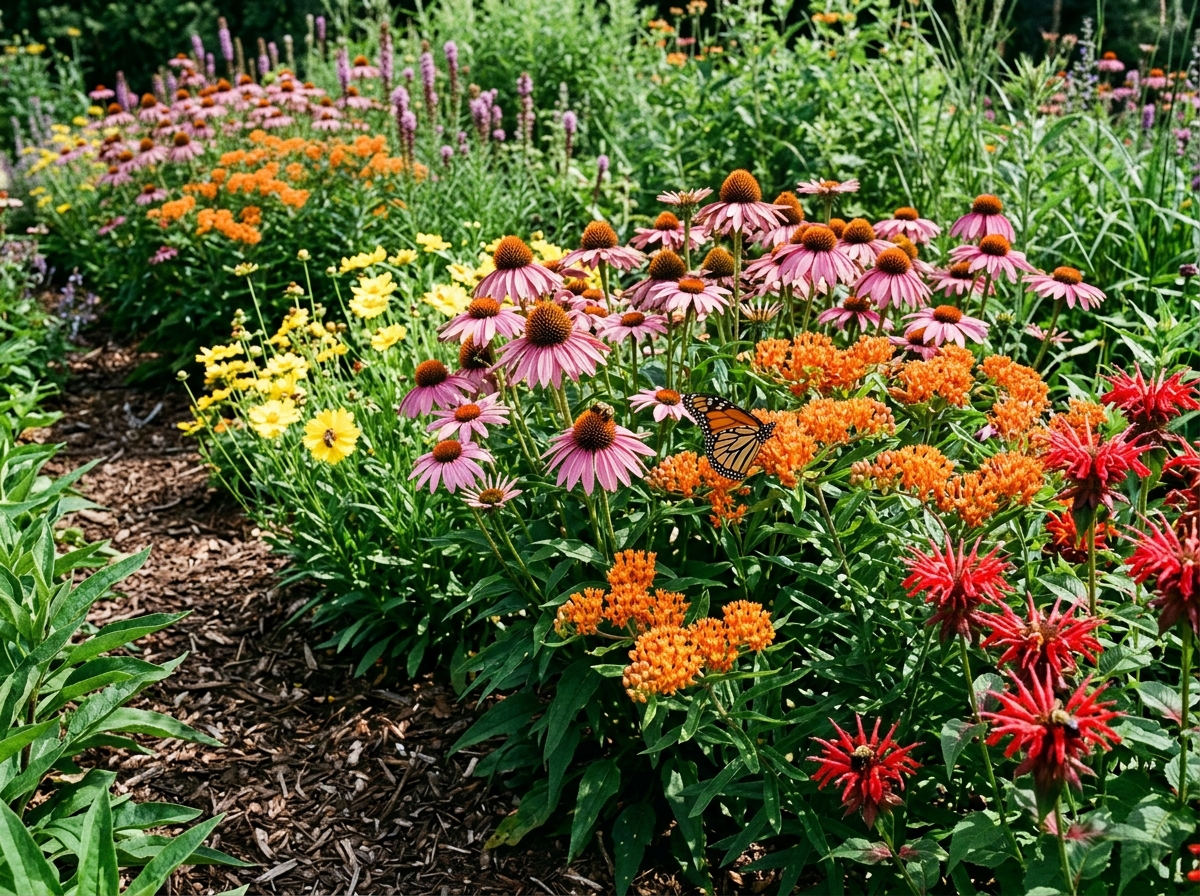
Nothing brings dynamic kinetic life to a sunny backyard like an intentional pollinator garden. The intense solar exposure triggers heavy nectar secretion in native prairie species, transforming your garden into an airport for honeybees, bumblebees, swallowtails, and hummingbirds from June through October.
Signature Flower Palette
- Purple Coneflower (Echinacea purpurea ‘Magnus’)
- Butterfly Weed (Asclepias tuberosa)
- Scarlet Bee Balm (Monarda didyma ‘Jacob Cline’)
- Threadleaf Coreopsis (Coreopsis verticillata ‘Moonbeam’)
- Blazing Star (Liatris spicata)
Design Formula & Layering Secrets
Group plants in broad clusters of at least 3 to 5 specimens per variety rather than dotting single plants. Pollinators navigate by visual color blocks; a 4-foot drift of vibrant orange Asclepias tuberosa alongside ruby-red Monarda makes an irresistible runway.
Growing Conditions & Maintenance: USDA Zones 3–9. These tough North American natives adapt to almost any well-drained soil type, from sandy loam to moderate clay, and possess deep taproots that make them impervious to midsummer droughts.
🌿 Horticulturist Pro-Tip: Resist the urge to tidy up this bed in late autumn. Leave the dried seed cones of Echinacea and Liatris standing all winter; they provide crucial emergency winter food for American goldfinches and essential shelter for overwintering beneficial insects.
#04. The Modern Prairie & Ornamental Grass Swath
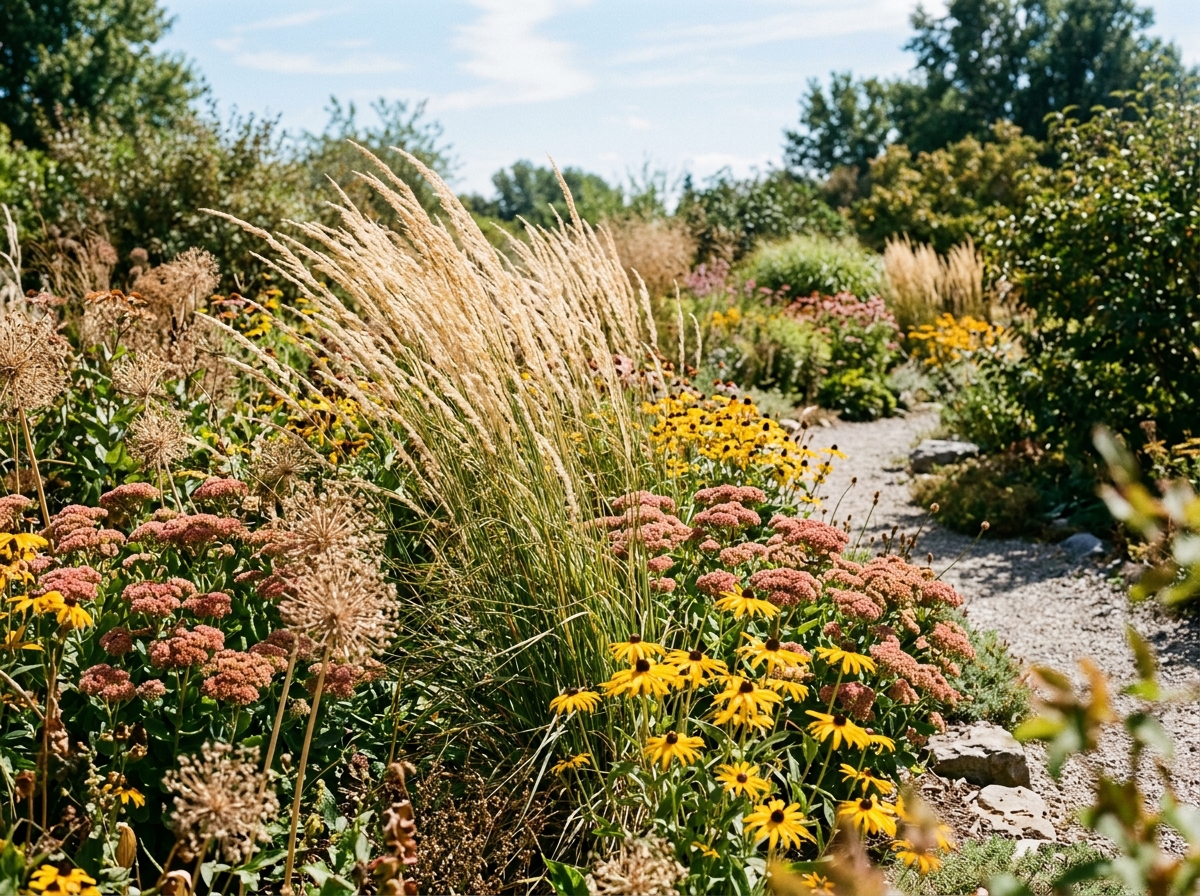
Inspired by the New Perennial movement spearheaded by Piet Oudolf, the modern prairie garden marries the architectural rhythm of structural ornamental grasses with long-flowering, drought-hardy perennials. It provides 12 months of structural interest, catching the wind in summer and holding frost in winter.
Signature Flower Palette
- Feather Reed Grass (Calamagrostis x acutiflora ‘Karl Foerster’)
- Stonecrop Sedum (Hylotelephium spectabile ‘Autumn Joy’)
- Black-Eyed Susan (Rudbeckia fulgida ‘Goldsturm’)
- Purple Dome Aster (Symphyotrichum novae-angliae)
- Globe Allium (Allium ‘Purple Sensation’ or ‘Millenium’)
Design Formula & Layering Secrets
Use ‘Karl Foerster’ feather reed grass as strong vertical sentinels that sway in the slightest breeze. Interplant them with flat, plate-like horizontal landing pads like Sedum ‘Autumn Joy’ and cheerful yellow daisy discs of Rudbeckia to establish an engaging rhythm of contrasting geometric silhouettes.
Growing Conditions & Maintenance: USDA Zones 4–9. Exceptional drought and heat tolerance. Thrives in full, blazing sun and average garden soil. Avoid heavy nitrogen fertilizers, which cause upright grasses to flop over.
🌿 Horticulturist Pro-Tip: Sedum Autumn Joy buds form pale green broccoli-like heads in early summer, turn rosy pink in August, deepen to rusty copper by October, and hold sturdy bronze seed heads through heavy winter snows.
#05. The Sun-Baked Alpine Rockery
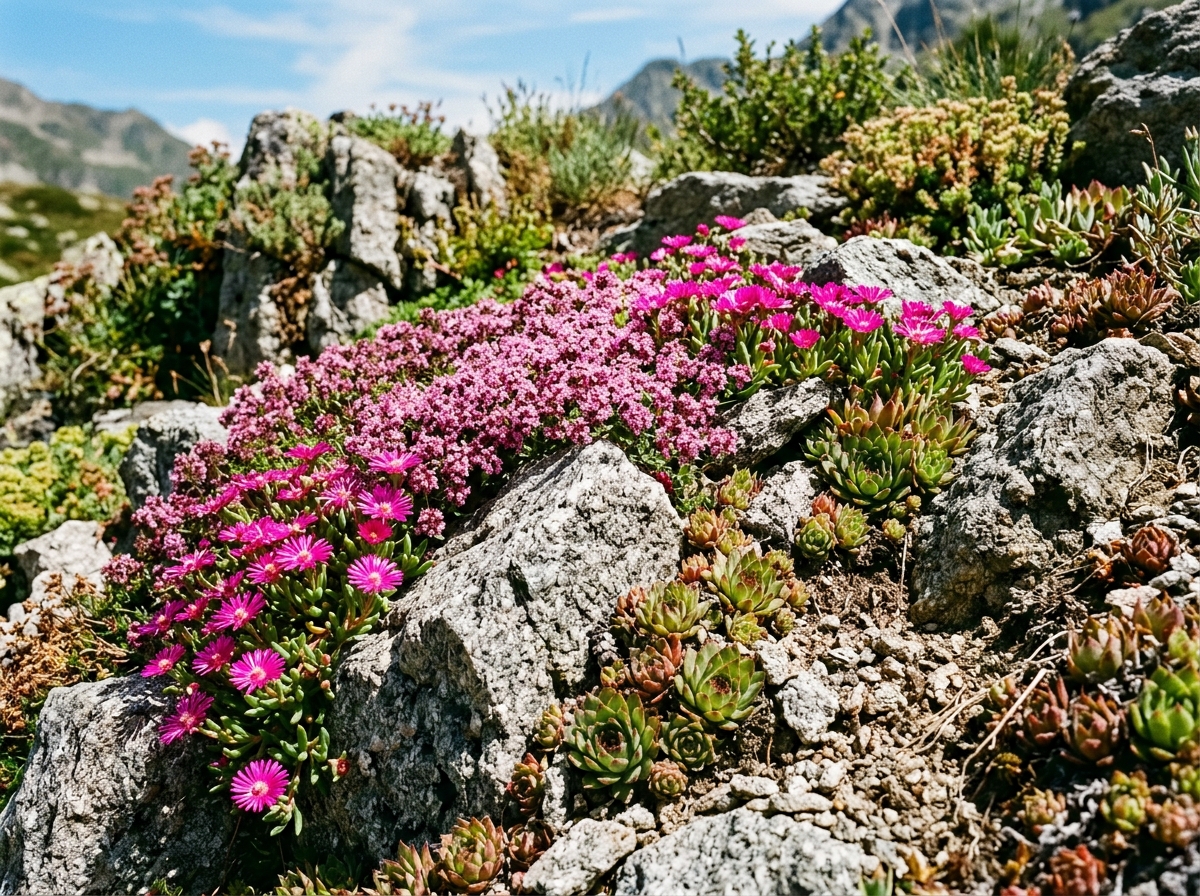
Slopes facing due south or west often turn into scorched dust bowls where ordinary garden perennials perish. An alpine rockery transforms this challenging microclimate into a jewel box of tough, prostrate succulents and creeping groundcovers that hug natural stone.
Signature Flower Palette
- Creeping Pink Thyme (Thymus serpyllum)
- Hardy Ice Plant (Delosperma cooperi)
- Hens and Chicks (Sempervivum tectorum)
- Creeping Phlox (Phlox subulata)
- Basket-of-Gold (Aurinia saxatilis)
Design Formula & Layering Secrets
Bury one-third to one-half of each large natural boulder into the ground so they appear as natural geological outcrops rather than dropped stones. Tuck Sempervivum rosettes directly into tight vertical rock cracks, and plant Delosperma and creeping thyme at the base to carpet the gritty slopes.
Growing Conditions & Maintenance: USDA Zones 4–10. Absolute requirement: razor-sharp drainage. Amend planting pockets with 50% coarse horticultural grit, pumice, or crushed granite. Standing winter water will rot these plants faster than drought ever could.
🌿 Horticulturist Pro-Tip: Delosperma flowers open their glossy neon-fuchsia petals only when the sun shines directly on them, closing quietly on cloudy days and at dusk to conserve precious moisture.
#06. The Backyard Cut-Flower Sanctuary
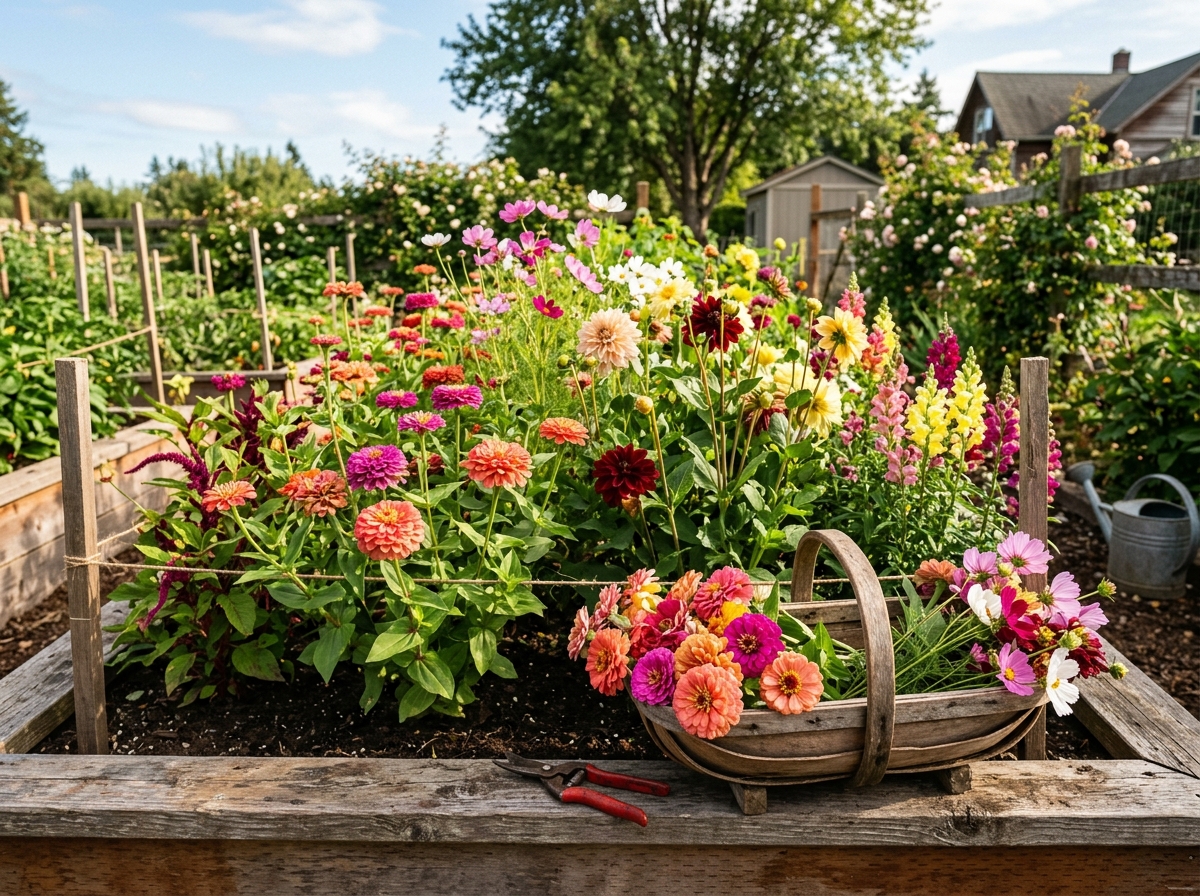
If your goal is filling mason jars and ceramic vases with fresh, home-grown arrangements every single morning, a dedicated full-sun cutting garden is pure magic. Full sunlight produces thick, sturdy stems that won’t bow under the weight of heavy double blooms.
Signature Flower Palette
- Giant Zinnias (Zinnia elegans ‘Benary\’s Giant’ or ‘Queen Lime Orange’)
- Dinnerplate & Decorative Dahlias (Dahlia pinnata)
- Feathery Cosmos (Cosmos bipinnatus ‘Sensation’)
- Rocket Snapdragons (Antirrhinum majus)
- Sweet Pea Vine (Lathyrus odoratus) & Sunflowers
Design Formula & Layering Secrets
Design in organized 3-to-4 foot wide raised beds or gridded garden rows accessible from both sides. Support tall dahlias and snapdragons with horizontal Hortonova netting or staked twine grids so heavy summer downpours won’t snap the floral stems.
Growing Conditions & Maintenance: USDA Zones 3–10 (grown as annuals or tender perennials). Require deep, moisture-retentive, fertile loam enriched with compost and a balanced organic granular fertilizer. Feed bi-weekly with liquid seaweed or fish emulsion.
🌿 Horticulturist Pro-Tip: Harvest flower stems early in the morning before 9 AM when the stems are fully turgid with sap. Cut deeply at a 45-degree angle just above a leaf node, and plunge immediately into a bucket of lukewarm, clean water.
#07. The Jewel-Tone Tropical Microclimate Border
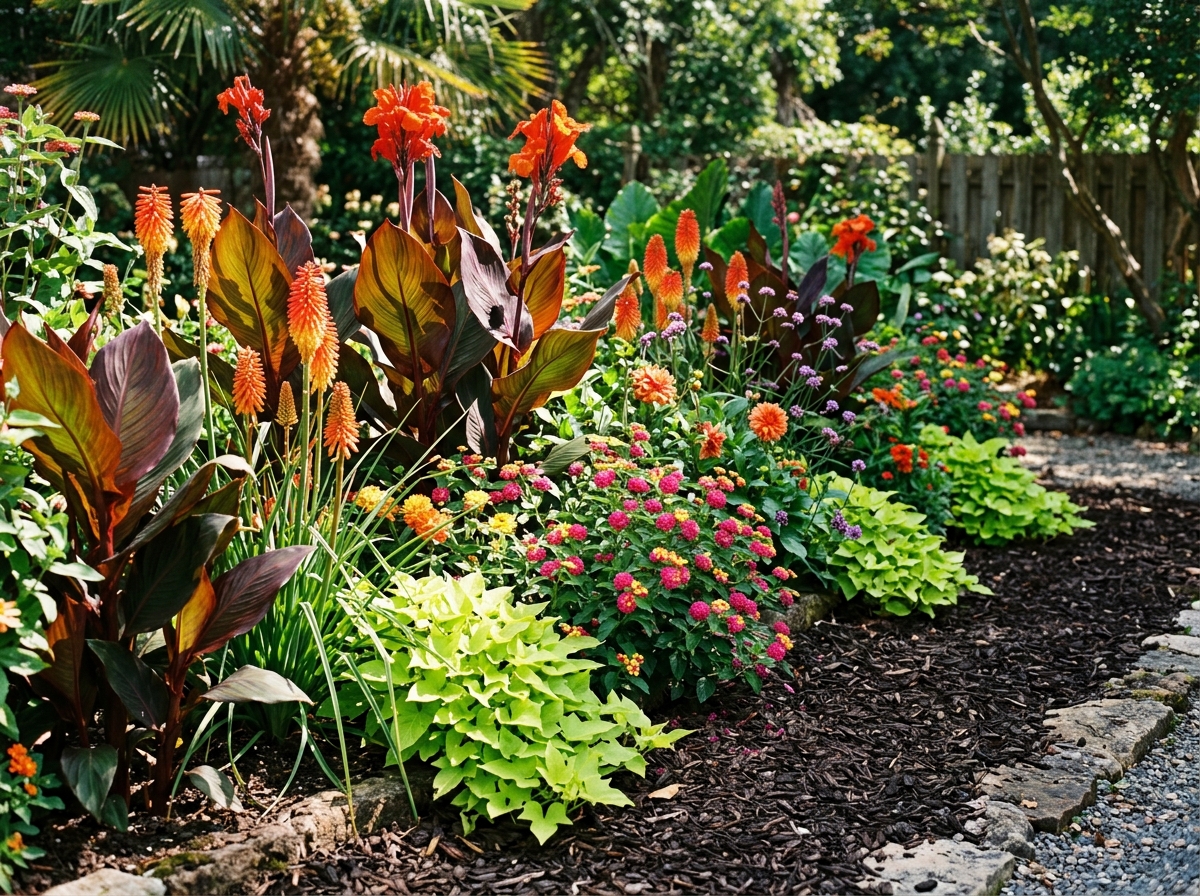
Full sun is an invitation to go bold. Instead of muted country pastels, a jewel-tone tropical border channels the fiery intensity of the high summer sun. Combining oversized, leathery leaves with electric scarlet, molten orange, and neon chartreuse creates a resort-worthy paradise in your own backyard.
Signature Flower Palette
- Bronze-Leaf Canna Lily (Canna ‘Tropicanna’ or ‘Australia’)
- Red-Hot Poker / Torch Lily (Kniphofia uvaria)
- Heat-Loving Lantana (Lantana camara)
- Chartreuse Sweet Potato Vine (Ipomoea batatas ‘Marguerite’)
- Mexican Sunflower (Tithonia rotundifolia)
Design Formula & Layering Secrets
Establish the backdrop with 6-foot tall bronze-foliaged Canna lilies whose paddle-shaped leaves catch backlit sunlight. In the mid-ground, plant upright Kniphofia torches and bushy multi-colored Lantana mounds. Underplant with neon lime-green sweet potato vine to ground the intense warm hues with punchy contrast.
Growing Conditions & Maintenance: USDA Zones 7–11 (or grown as annuals/overwintered rhizomes in cooler zones). Need hot sun, regular irrigation, and high organic matter to feed their massive leaves.
🌿 Horticulturist Pro-Tip: In zones 6 and colder, lift canna rhizomes after the first autumn frost blackens the foliage. Store the dormant tubers in dry peat moss in a cool, dark basement (45–50°F) until replanting next spring.
#08. The Fragrant Sunset Sensory Garden
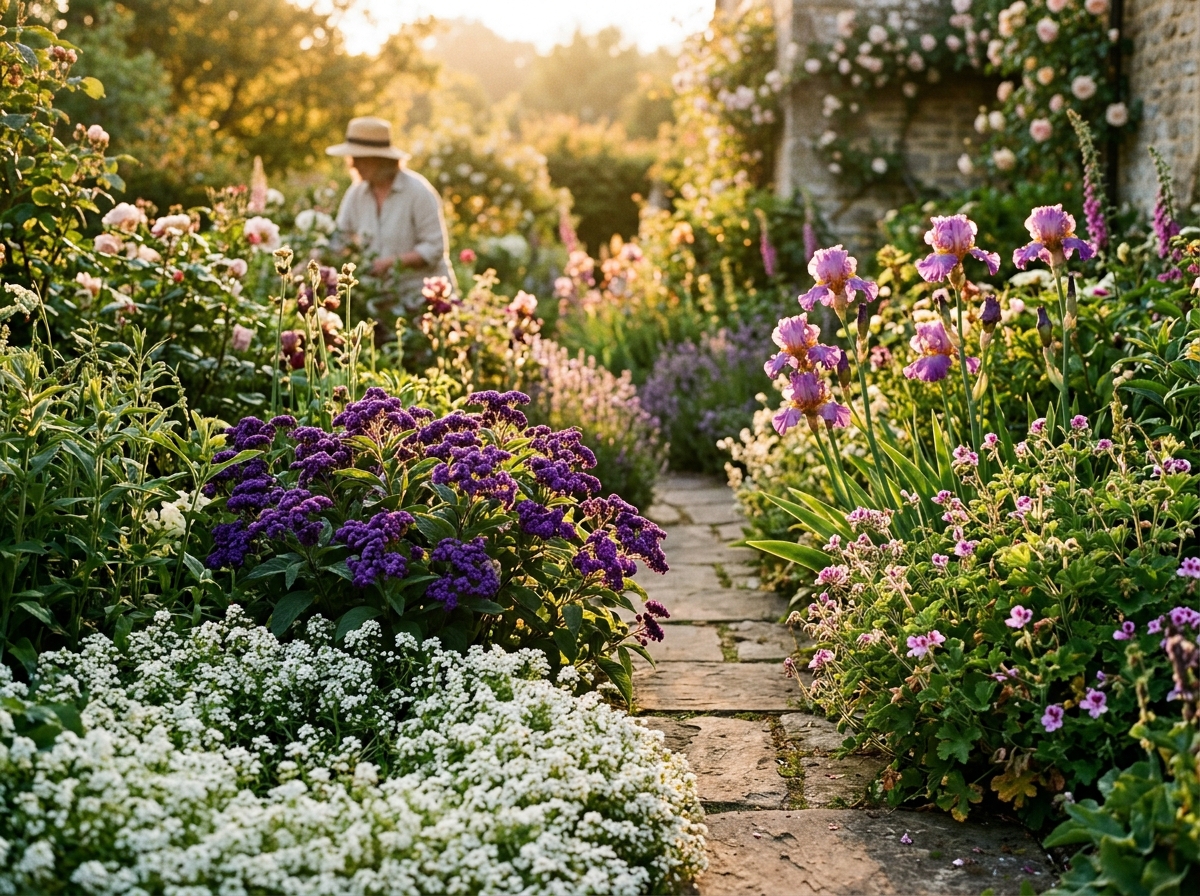
Sunlight acts as an essential catalyst for plant scent, warming the volatile essential oils stored in flower petals and glandular leaf hairs. Positioned beside a sunny patio, deck, or frequently opened window, this sensory garden releases waves of vanilla, spicy clove, and warm honey as the sun dips below the horizon.
Signature Flower Palette
- Royal Heliotrope (Heliotropium arborescens ‘Marine’)
- Sweet Alyssum (Lobularia maritima)
- Tall Bearded Iris (Iris germanica)
- Night-Scented Stock (Matthiola bicornis)
- Scented Geranium (Pelargonium graveolens)
Design Formula & Layering Secrets
Line walkways with tactile scented geraniums and a dense white edging of honey-scented sweet alyssum that releases fragrance whenever brushed against. Cluster royal purple heliotrope in large swaths near seating areas to catch prevailing evening breezes.
Growing Conditions & Maintenance: USDA Zones 4–9 depending on species. Requires fertile, well-draining loamy soil and at least 6 hours of full direct sunshine to maximize essential oil production.
🌿 Horticulturist Pro-Tip: Sweet alyssum is one of the most cost-effective and pollinator-attractive companion plants in existence. When it looks slightly tired in late July heat, give it a quick trim with hedge shears to spur continuous autumn bloom.
#09. The Tiered Cedar Raised Bed Tapestry
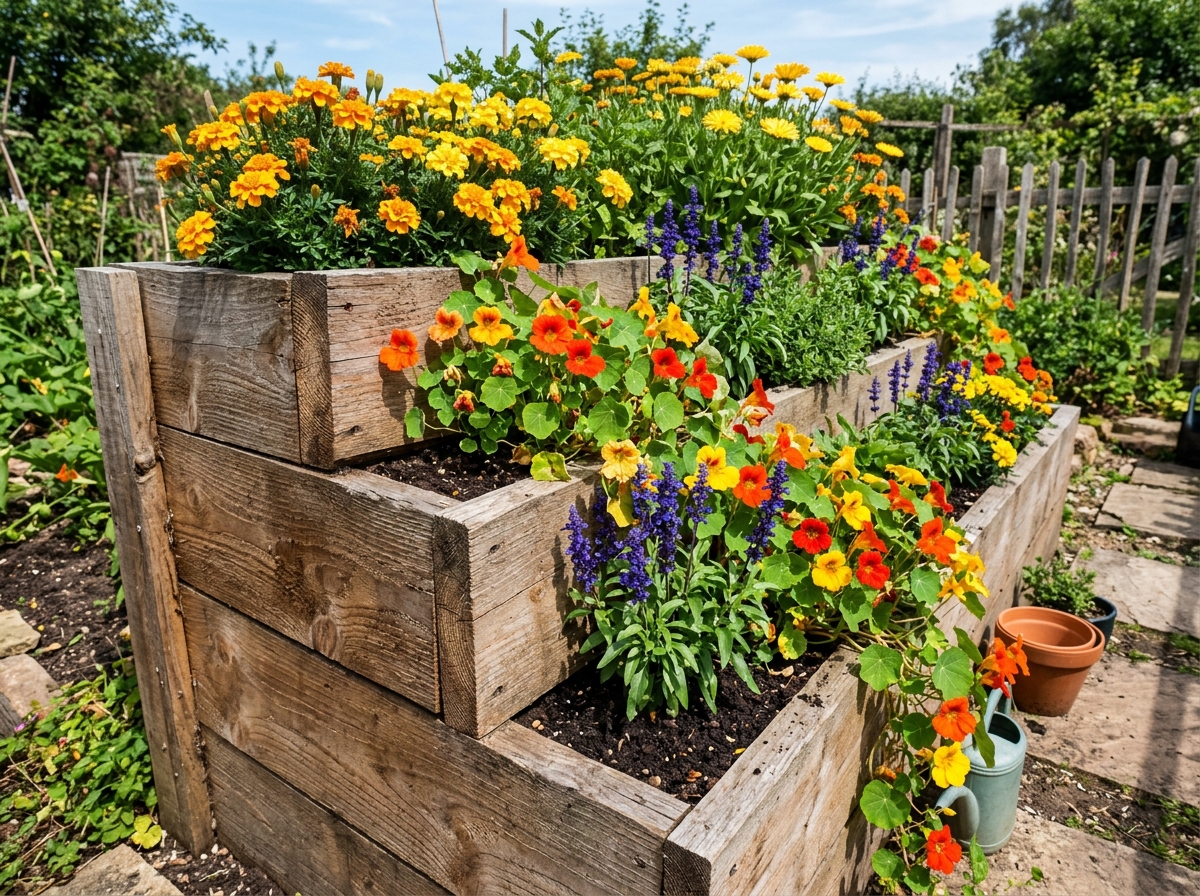
If your yard has poor, unyielding clay, heavy compaction, or concrete surroundings, tiered cedar raised beds maximize vertical planting real estate in full sun. By stepping the planting planes upward, each flower tier receives uninhibited sun without casting shade on its neighbors.
Signature Flower Palette
- French Marigolds (Tagetes patula)
- Trailing Nasturtiums (Tropaeolum majus ‘Empress of India’)
- Mealycup Blue Salvia (Salvia farinacea ‘Victoria Blue’)
- Pot Marigold (Calendula officinalis)
- Zonal Flowering Geraniums (Pelargonium)
Design Formula & Layering Secrets
Place tall, drought-resistant Salvia farinacea and upright Calendula on the highest tier. Fill the mid tier with dense golden French marigolds. On the lowest level, plant trailing nasturtiums so their saucer-like emerald leaves and spicy edible orange flowers cascade gracefully over the raw wood planks.
Growing Conditions & Maintenance: Suitable for all growing zones. Fill boxes with a custom mix of 60% topsoil, 30% organic compost, and 10% perlite or vermiculite. Because raised beds warm up earlier in spring and drain flawlessly, they allow you to plant two weeks ahead of in-ground beds.
🌿 Horticulturist Pro-Tip: Nasturtium blossoms and young leaves are 100% edible, offering a crisp, peppery watercress kick that elevates summer salads, while their root exudates naturally deter garden nematodes.
#10. The Monarch & Butterfly Highway
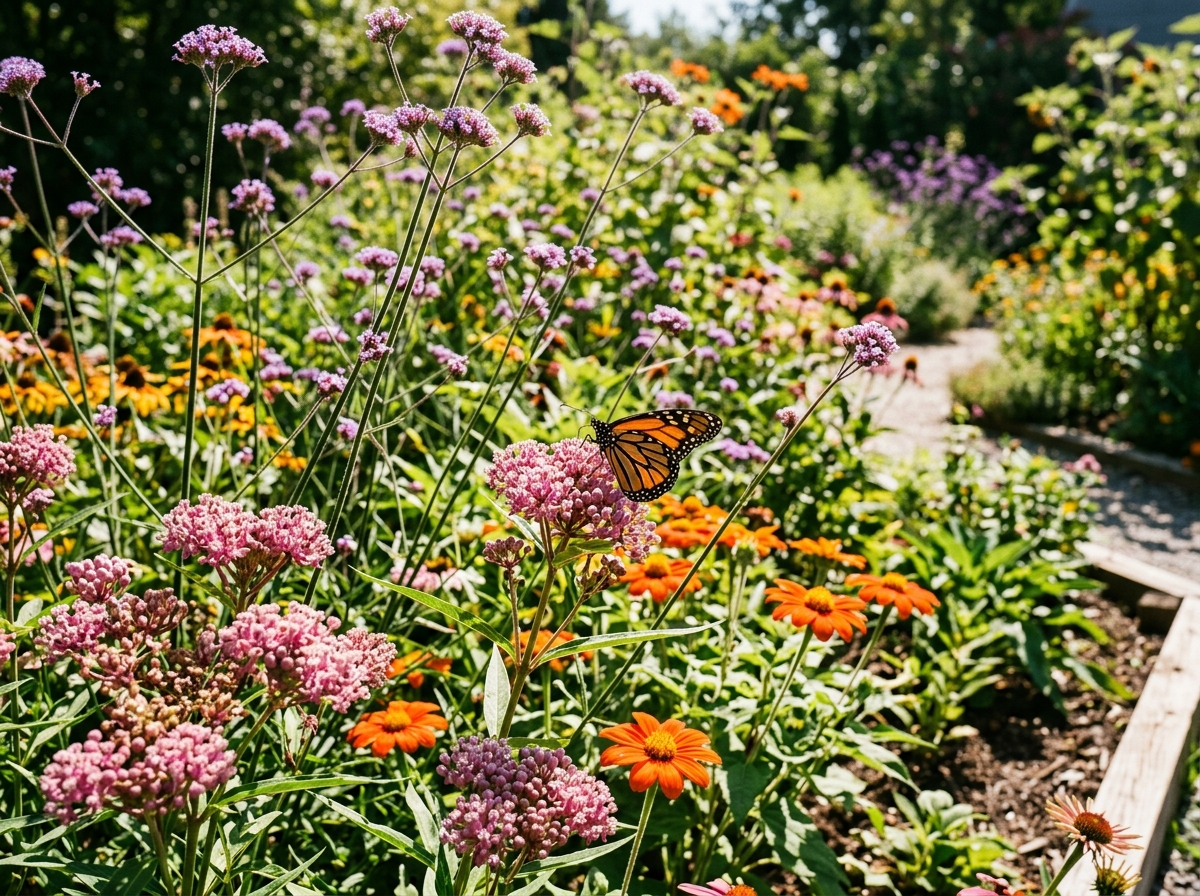
Butterflies are solar-powered creatures; they rely on direct ambient sunshine to elevate their wing muscle temperature before they can take flight. A dedicated full-sun butterfly corridor planted with native host plants and high-octane nectar sources creates a critical sanctuary along migratory corridors.
Signature Flower Palette
- Tall Purple Verbena (Verbena bonariensis)
- Swamp Milkweed (Asclepias incarnata)
- Mexican Sunflower (Tithonia rotundifolia ‘Torch’)
- New England Aster (Symphyotrichum novae-angliae)
- Joe Pye Weed (Eutrochium purpureum)
Design Formula & Layering Secrets
Create a tiered backdrop of 6-foot tall Joe Pye Weed and fiery orange Tithonia. In the mid-ground, plant clumps of Asclepias incarnata (vital host plant for monarch caterpillars). Weave Verbena bonariensis throughout; its transparent, airy stems allow you to see right through the purple blossom clusters to the flowers behind.
Growing Conditions & Maintenance: USDA Zones 3–9. Adaptable, sun-loving perennials that thrive in moist to average well-drained soils. Avoid synthetic chemical pesticides and systemic insecticides at all costs.
🌿 Horticulturist Pro-Tip: Include a shallow flat stone in a sheltered, sun-drenched spot with a sprinkle of mineral-rich damp sand. Butterflies will gather there to bask in the sun and engage in ‘puddling’ to absorb essential salts and minerals.
#11. The Soft Romantic Pastel Perennial Border
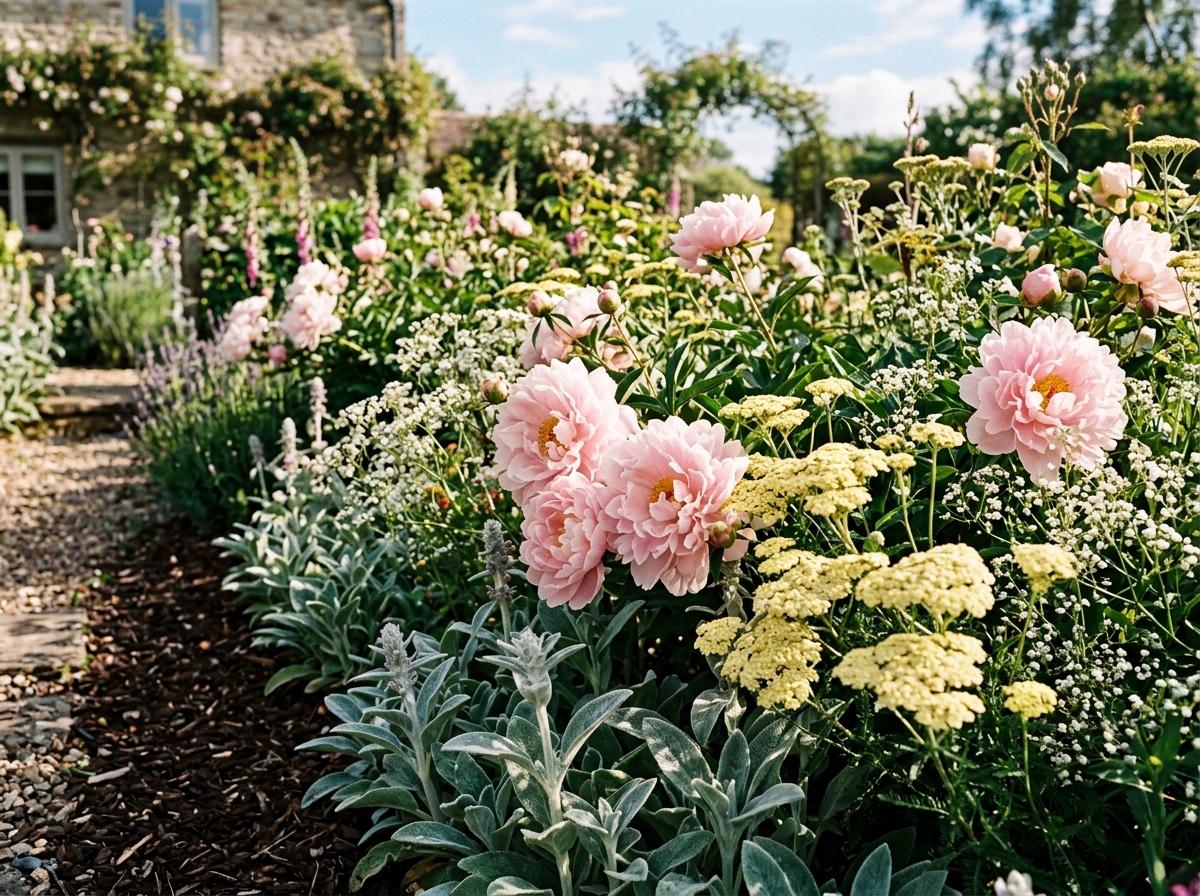
For gardeners who find vibrant neon hues jarring under harsh midday light, a soft pastel border creates a serene, cooling visual oasis. Cool blush pinks, creamy whites, soft primrose yellows, and velvety silver foliage diffuse harsh direct solar rays, imparting an ethereal elegance to the landscape.
Signature Flower Palette
- Herbaceous Peony (Paeonia lactiflora ‘Sarah Bernhardt’)
- Moonshine Yarrow (Achillea ‘Moonshine’)
- Lamb\’s Ear (Stachys byzantina ‘Helene von Stein’)
- Perennial Baby\’s Breath (Gypsophila paniculata)
- Hardy Cranesbill Geranium (Geranium ‘Johnson\’s Blue’)
Design Formula & Layering Secrets
Showcase heavy-headed pink peonies as the crown jewels of early summer. Interlace their foliage with the flat, sulfur-yellow plates of Achillea ‘Moonshine’ and clouds of frothy white baby’s breath. Finish the front border with a dense ribbon of silver, tactile Lamb’s Ear to create a velvety soft edging.
Growing Conditions & Maintenance: USDA Zones 3–8. Peonies require full sun and cold winter chill hours to set their flower buds. Ensure peonies are never planted more than 2 inches below soil level, or they will refuse to bloom.
🌿 Horticulturist Pro-Tip: The dense silver hairs covering Lamb’s Ear foliage act as microscopic parasols, reflecting intense solar radiation and trapping a layer of still, humid air against the leaf surface to dramatically prevent water loss.
#12. The Sunny Terracotta Container Cluster
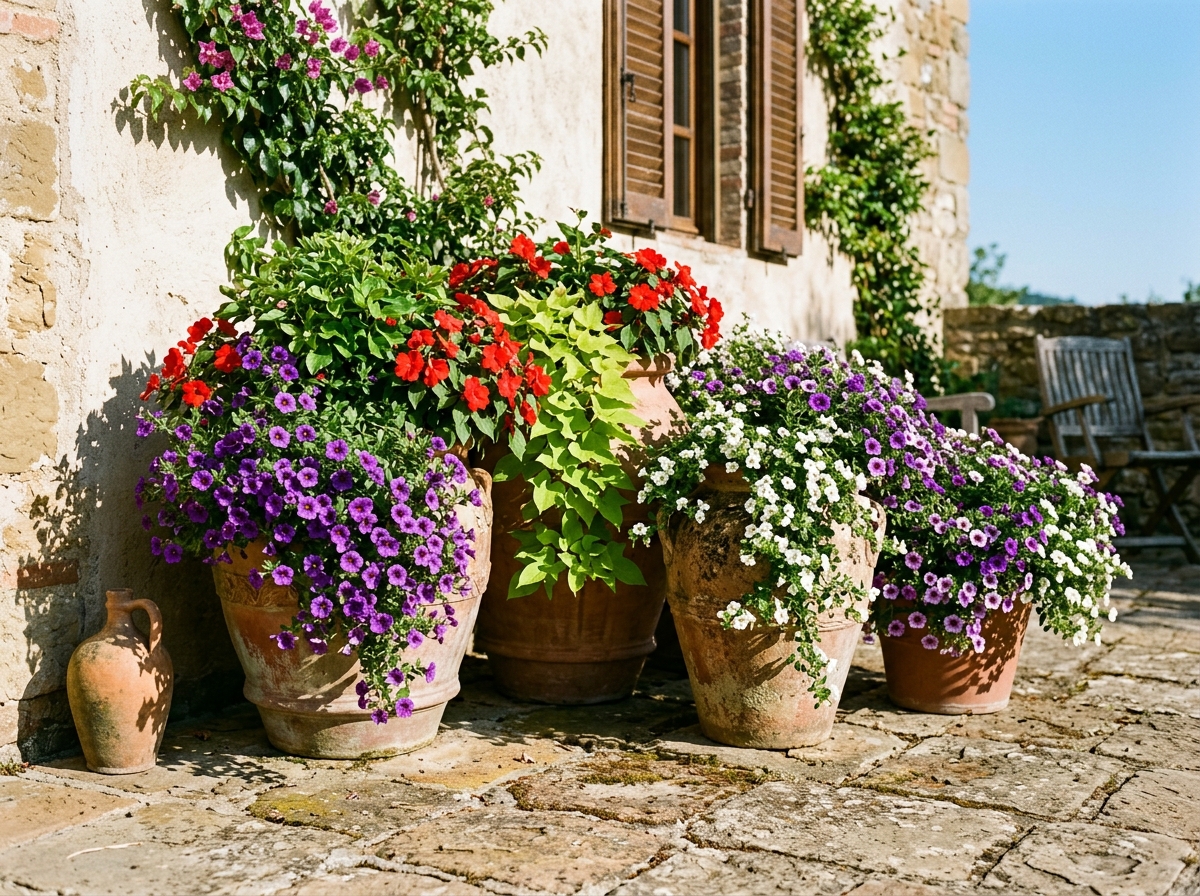
You don’t need sprawling garden acreage to create a breathtaking full-sun floral display. A curated cluster of aged terracotta pots grouped on a sunny patio, deck, or balcony concentrates dazzling color into a compact footprint while offering complete control over soil conditions.
Signature Flower Palette
- Million Bells (Calibrachoa ‘Superbells Grape Punch’)
- SunPatiens (Impatiens hybrida ‘Compact Hot Coral’)
- Sweet Potato Vine (Ipomoea batatas ‘Margarita’)
- Trailing Bacopa (Sutera cordata)
- Trailing Rosemary (Rosmarinus officinalis ‘Prostratus’)
Design Formula & Layering Secrets
Follow the classic container design rule: ‘Thriller, Filler, and Spiller’. Use upright SunPatiens or dwarf ornamental grasses as the central thriller; pack mounding Calibrachoa as colorful fillers; and let chartreuse sweet potato vine and trailing bacopa spill over the clay rims to touch the paving stones.
Growing Conditions & Maintenance: Ideal for all zones during frost-free months. Porous terracotta pots breathe naturally, allowing oxygen to reach root balls and preventing root rot. However, terracotta dries out swiftly under intense sun; use a high-quality potting mix enriched with water-retentive coconut coir.
🌿 Horticulturist Pro-Tip: Install simple battery-operated drip irrigation tubing tucked discreetly behind the pots. Delivering a slow, steady trickle of water directly to the roots each morning eliminates the drudgery of dragging heavy watering cans twice a day.
#13. The Midnight & Gold High-Contrast Border
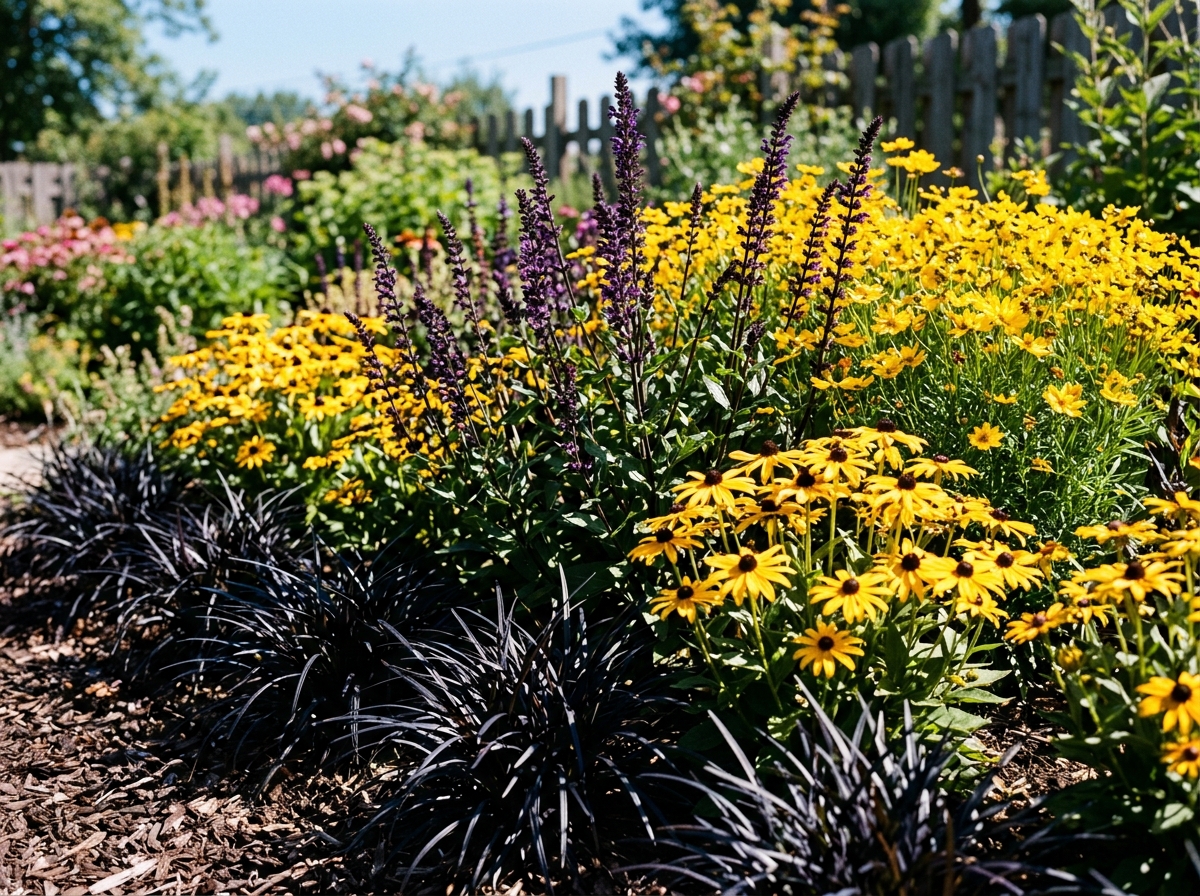
One of the most striking design tricks used by landscape architects in full sun is high visual contrast. Direct sunlight can wash out subtle tones, but when you juxtapose near-black foliage and deep purple flower spires against luminous molten golds, every single plant pops with graphic intensity.
Signature Flower Palette
- Black Mondo Grass (Ophiopogon planiscapus ‘Nigrescens’)
- Woodland Sage (Salvia nemorosa ‘Caradonna’)
- Black-Eyed Susan (Rudbeckia fulgida ‘Goldsturm’)
- Threadleaf Coreopsis (Coreopsis ‘Zagreb’)
- Dark Foliage Sedum (Sedum ‘Touchdown Teak’ or ‘Voodoo’)
Design Formula & Layering Secrets
Plant a deep border edge of inky, jet-black strappy Black Mondo Grass. Directly behind it, establish large swaths of luminous golden-yellow Rudbeckia ‘Goldsturm’. Intermix with the slender, deep-violet vertical spikes of Salvia ‘Caradonna’, whose dark purple stems accentuate the contrast.
Growing Conditions & Maintenance: USDA Zones 5–9. Thrives in average, well-draining garden soils with 6+ hours of uninterrupted sunlight. The dark pigments (anthocyanins) in the black and purple foliage actually intensify under stronger UV light exposure.
🌿 Horticulturist Pro-Tip: Mulch this bed with shredded dark brown cedar mulch or black pine bark fines. The dark groundcover eliminates light glare and amplifies the radiant yellow petals of the Rudbeckia.
#14. The Naturalized Native Wildflower Meadow
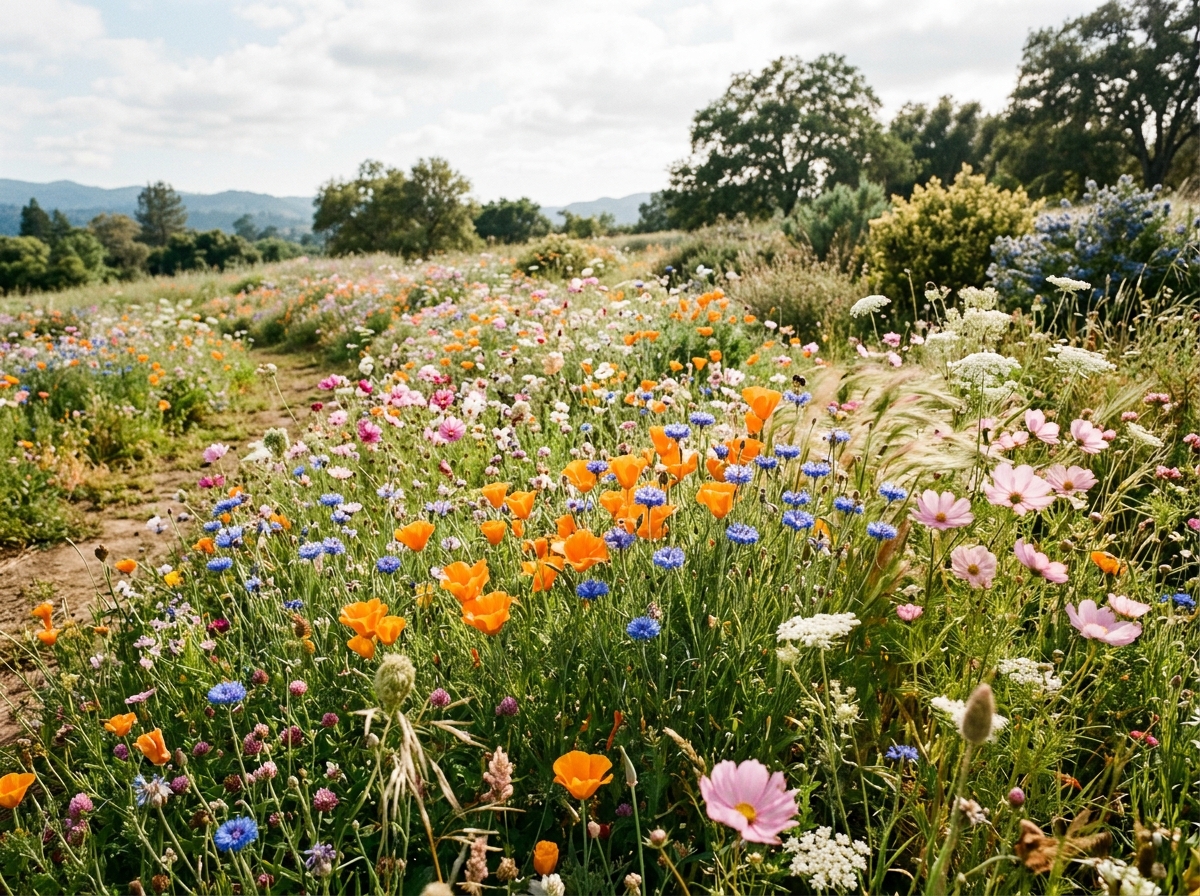
If you have a wide, sunny expanse of lawn that consumes too much mowing time, fuel, and municipal water, converting it into a naturalized wildflower meadow drift is an ecological triumph. This design celebrates wild, unscripted beauty while creating an oasis for native bees, predatory wasps, and finches.
Signature Flower Palette
- California Poppy (Eschscholzia californica)
- Blue Cornflower / Bachelor’s Button (Centaurea cyanus)
- Wild Cosmos (Cosmos bipinnatus)
- Plains Coreopsis (Coreopsis tinctoria)
- Bishop’s Flower / False Queen Anne’s Lace (Ammi majus)
Design Formula & Layering Secrets
Direct-seed a high-quality regional wildflower seed blend combined with fine sand (1 part seed to 4 parts sand) for even dispersal across bare, scarified soil. Allow flowers to intermingle naturally, creating undulating waves of electric orange poppies, cobalt cornflowers, and lacey white umbels.
Growing Conditions & Maintenance: USDA Zones 3–10. Native wildflowers thrive in lean, unfertilized soil. High nitrogen causes excessive floppy leaf growth at the expense of floral blooms.
🌿 Horticulturist Pro-Tip: In late autumn, after the wildflower drift has fully dropped its seed heads, set your mower to its highest setting (6 to 8 inches) and mow the meadow once. This distributes seeds into the soil and prevents woody tree saplings from invading.
#15. The Autumn Revival Late-Season Showcase
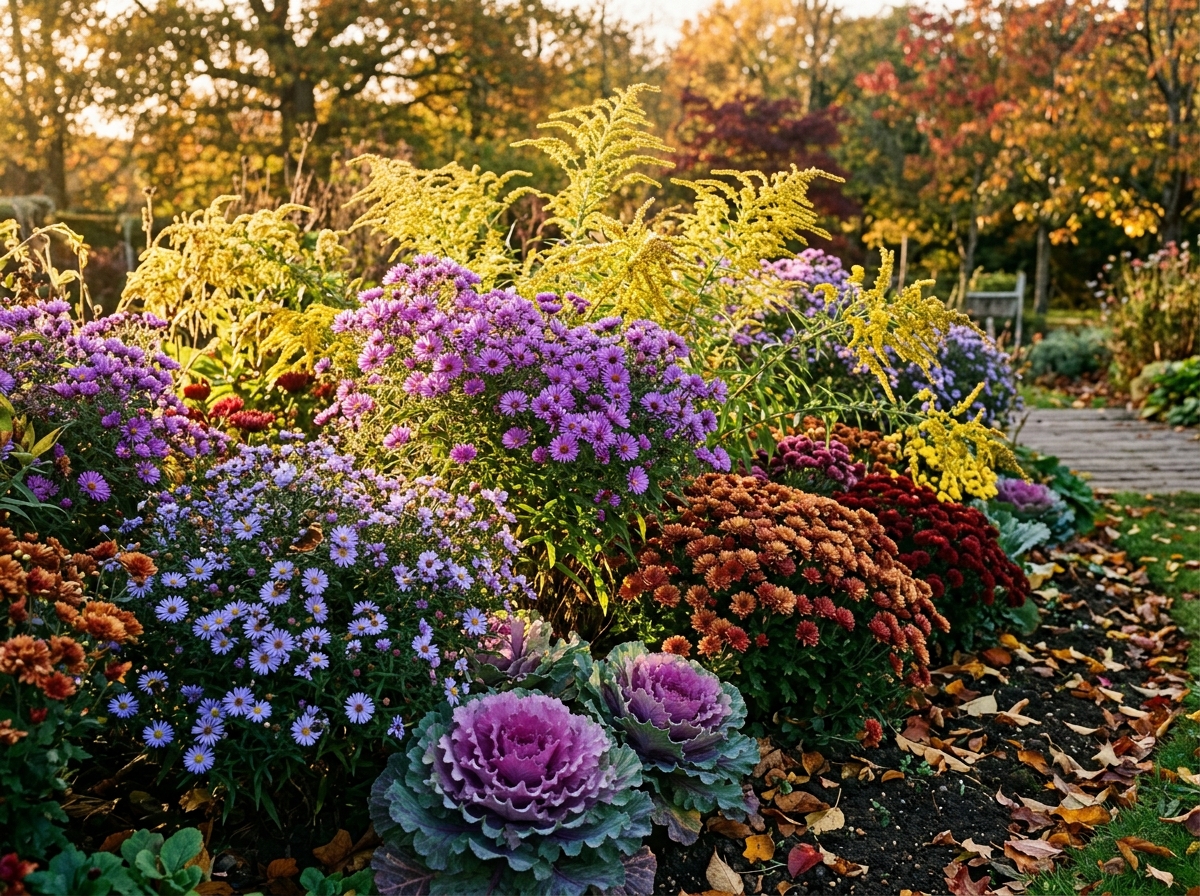
Most gardeners focus exclusively on May and June, leaving their garden borders tired, brown, and spent when September arrives. An Autumn Revival sun border peaks precisely when the rest of the neighborhood goes dormant, bursting into electric purples, coppers, and golds that shrug off early frosts.
Signature Flower Palette
- New England Aster (Symphyotrichum novae-angliae ‘Alma Potschke’)
- Hardy Garden Mums (Chrysanthemum grandiflorum)
- Showy Goldenrod (Solidago speciosa ‘Fireworks’)
- Ornamental Flowering Cabbage & Kale (Brassica oleracea)
- Japanese Anemone (Anemone x hybrida ‘Honorine Jobert’)
Design Formula & Layering Secrets
Place feathery, arching sprays of goldenrod ‘Fireworks’ in the back layer alongside tall purple asters. Fill the middle with rounded mounds of copper and burgundy garden mums. Edge the border with ruffled purple and emerald ornamental flowering kale, whose colors intensify dramatically as temperatures plunge.
Growing Conditions & Maintenance: USDA Zones 4–9. Full sun is essential to prevent asters and mums from becoming leggy. Keep soil evenly moist through late summer to support the massive energy requirements of late-season bud formation.
🌿 Horticulturist Pro-Tip: Perform the famous ‘Chelsea Chop’ in late May or early June: cut back the stems of asters and goldenrod by one-third to one-half. This delays blooming by two weeks, doubles the number of flowering branches, and keeps plants compact without needing staking.
5 Golden Rules for Designing a Thriving Full-Sun Flower Garden
Regardless of whether you choose a breezy English cottage border or a rugged Mediterranean gravel scape, thriving in 6 to 8+ hours of direct summer heat hinges on these five fundamental horticultural practices:
1. Prioritize Deep, Morning Irrigation Over Frequent Sprinkles
Shallow afternoon watering in full sun results in rapid evaporation and encourages weak, surface-level roots that bake when the soil heats up. Instead, water your full-sun beds deeply (1 to 1.5 inches of water per week) at soil level between 5 AM and 8 AM. Early morning watering allows moisture to soak deep into the subsoil while allowing plant foliage to dry quickly, virtually eliminating fungal diseases like powdery mildew.
2. Insulate Soil Temperature with a 3-Inch Organic Mulch Blanket
Uncovered soil in full direct sunlight can easily reach temperatures exceeding 110°F (43°C), killing beneficial mycorrhizal fungi and roasting root hairs. Maintain a continuous 2-to-3 inch blanket of shredded bark, arborist woodchips, or pine needles. Organic mulch moderates root temperatures by up to 20 degrees, locks in soil moisture, and naturally breaks down into fertile humus.
3. Master the Art of Deadheading to Multiply Bloom Flushes
A plant’s biological goal is not to look pretty for your viewing pleasure; its sole evolutionary objective is to produce viable seeds. When spent flower heads are left on coneflowers, zinnias, salvia, and roses, the plant diverts its energy from flower bud production to seed maturation. Snip off fading blooms weekly down to the first set of healthy leaves to trigger continuous flushes all summer long.
4. Layer by Height and Solar Aspect (The North-South Rule)
To prevent tall sun-loving perennials from shading out compact companions, always organize your beds according to solar orientation. Place your tallest specimens (delphiniums, sunflowers, cannas, Joe Pye weed) at the north or east side of the bed, tapering down to medium perennials in the center, and trailing groundcovers (thyme, alyssum, sedum) on the south and west edges where they can bask in full light.
5. Select Climate-Appropriate Ecotypes & Native Perennials
Full sun in Seattle is vastly different from full sun in Dallas or Phoenix. While direct UV exposure may be identical in hours, ambient humidity and thermal heat index dictate plant performance. Always verify cold hardiness and heat tolerance (AHS Heat Zones), and prioritize native prairie and Mediterranean ecotypes that have evolved over millennia to withstand intense solar radiation with zero artificial pampering.
Frequently Asked Questions
What flower blooms all summer long in full direct sun?
For non-stop color from late May through first frost, annuals like Benary’s Giant Zinnias, SunPatiens, and Lantana bloom continuously without resting. Among hardy perennials, Purple Coneflowers (Echinacea), Black-Eyed Susans (Rudbeckia ‘Goldsturm’), Threadleaf Coreopsis (‘Moonbeam’), and Hardy Geranium (‘Rozanne’) offer the longest continuous bloom cycles in full sun, often flowering for 12 to 16 consecutive weeks if deadheaded regularly.
How often should you water a flower garden in full sun?
As a general rule, established in-ground full sun perennials require 1 to 1.5 inches of water per week, delivered in one or two deep soakings rather than brief daily sprinklings. However, newly planted perennials need watering every 2 to 3 days for the first month until their roots anchor into the native soil. Container plantings in full sun dry out much faster and may require daily watering during the peak heat of July and August.
How do you prevent flowers from burning or scorching in extreme sun?
To prevent solar scorch, ensure your soil is rich in moisture-holding organic compost, maintain a thick 3-inch layer of organic mulch over the root zone, and water exclusively at the base of the plant in the early morning. Avoid getting water droplets on broad leaves at midday, as standing droplets can act as miniature magnifying lenses under intense solar radiation.
Can I grow hydrangeas in a full sun flower garden?
Most classic bigleaf hydrangeas (Hydrangea macrophylla) wilt and scorch in intense afternoon sun. However, Panicle Hydrangeas (Hydrangea paniculata, such as ‘Limelight’, ‘Bobo’, and ‘Vanilla Strawberry’) thrive in full sun conditions, provided their soil remains moist and well-mulched. Their conical white and lime-green blooms love full sun and turn gorgeous shades of dusky pink in autumn.
What are the best low-maintenance perennial flowers for poor, dry soil in full sun?
The top zero-fuss champions for dry, rocky, or sandy soil in full sun are Russian Sage (Perovskia), English Lavender (Lavandula), Stonecrop Sedum (‘Autumn Joy’), Yarrow (Achillea), Purple Coneflower (Echinacea), and Butterfly Weed (Asclepias tuberosa). Once their root systems establish during the first growing season, they survive effortlessly on natural rainfall alone.
Bring Your Full-Sun Garden to Life
Direct summer sun isn’t a gardening obstacle—it is the ultimate solar engine for explosive color, deep sweet perfumes, and vibrant pollinator activity. Start with healthy amended soil, install a deep blanket of mulch, select two or three of the design palettes above, and watch your sun-soaked yard transform into an unforgettable living sanctuary.


0 Comments